

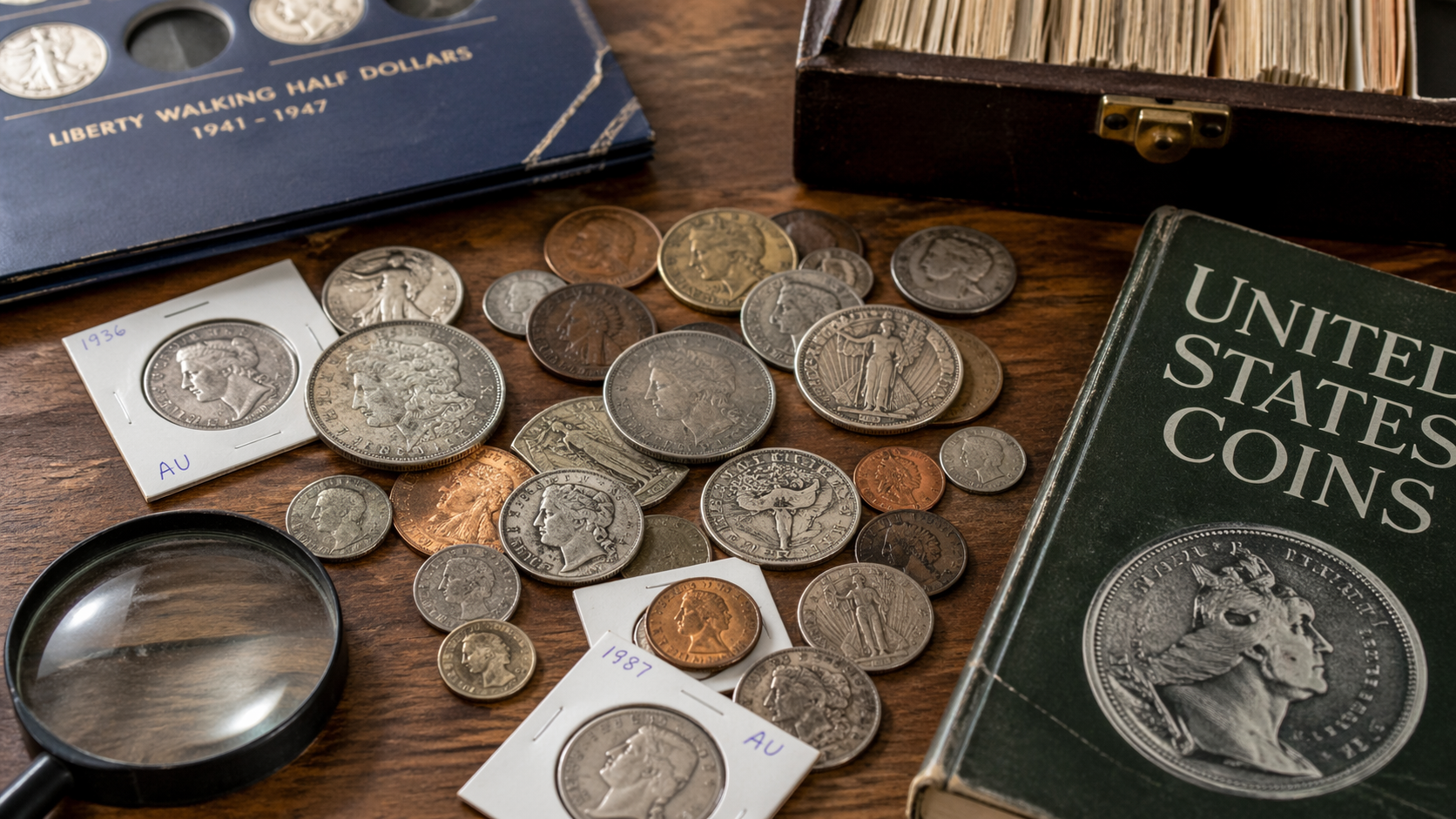
You're cleaning out a drawer, sorting through an old shoebox, or settling a loved one's estate — and you find a collection of coins. Maybe a few rolled pennies, a handful of silver dollars, or a velvet-lined case full of something you can't quite identify. The question hits immediately: are these worth anything?
It's one of the most common things we hear from Maryland families, and the answer is almost always: it depends — but more often than you'd think, the answer is yes.
Knowing what to look for can mean the difference between passing over a $500 coin or accidentally spending a $2,000 one. This guide walks you through the key indicators of coin value, the types of coins most likely to be worth real money, and what your next step should be if you think you might have something.
Why Old Coins Are So Often Misunderstood
Most people assume that age alone makes a coin valuable. That's a natural conclusion — older things tend to be rarer, right? But in the world of numismatics (the formal term for coin collecting), age is just one piece of a complicated puzzle.
Some historic 2,000-year-old Roman bronze coins are so common and easily available that they can be purchased for as little as $25 or $50 each. Nasdaq Meanwhile, a 1975 Roosevelt dime proof coin missing its "S" mintmark — struck just 50 years ago — has been valued around $450,000, with only two known in circulation. Pinehurst Coins
The point: rarity, condition, demand, and metal content matter far more than age alone. Let's break each of those down.
The 6 Key Factors That Determine a Coin's Value
1. Metal Content: The Floor Beneath Every Coin's Value
Before anything else, ask yourself: what is this coin actually made of?
For U.S. coins, this question has a clear historical dividing line. Prior to 1965, most coins minted in the United States were 90% silver and 10% copper. By 1970, silver was eliminated from all coin circulation in the United States. U.S. Gold Bureau
This matters enormously today. US dimes, quarters, and half dollars dated 1964 or earlier are 90% silver. They have a solid gray edge with no copper stripe. Kennedy halves from 1965 to 1970 are 40% silver and also have a mostly silver-colored edge. Busby Antiques
With silver trading near multi-year highs in 2026, even a common, worn pre-1965 coin is worth significantly more than its face value based on metal content alone. Washington quarters dated 1964 or earlier are 90% silver — one silver quarter is often worth 15 to 25 times its face value depending on silver prices. Many people unknowingly spend them or leave them sitting in jars. MoneyMade
One critical nuance: wartime Jefferson nickels from 1942 to 1945 used a special alloy containing 35% silver. These can be identified by the large mint mark above Monticello. MoneyMade
2. Rarity: The Scarcest Coins Carry the Biggest Premiums
Every coin has a mintage number that indicates how many examples of that exact coin were made at that origin of mintage. The lower the mintage, the higher the value of the coin. Low mintages often lead to lower survival rates for older coins, and lower mintage coins are also coveted by many collectors, which can help increase their numismatic value. Nasdaq
But mintage figures only tell part of the story. Survival rate matters just as much. Over 270 Morgan silver dollars were melted down in 1918, making the ones that survived very valuable. Coinfully
This is also why the tiny mint mark stamped on a coin matters so much. In the $20 Saint-Gaudens series, a 1920 Philadelphia issue has a population of 5,440 certified examples, yet that same year, a San Francisco minted Saint has a population of only 85 — making the 1920-S far more valuable than the 1920. Mint State Gold
3. Condition (Grade): A Perfect Coin Can Be Worth 100x a Worn One
Coin condition is measured on the Sheldon Scale, a numeric grade from 1 to 70. The date and mintmark indicate how many of a given coin were struck (the mintage), but rarity isn't everything — grade dramatically affects what makes a coin valuable. Even at lower circulated grades a rare coin holds significant value, but in higher Mint State grades its price climbs into six and even seven figures. Archangel Coins
Tens of millions of Liberty Head design nickels were made at the United States Mint in Philadelphia from the late 1880s to early 1900s, and most of them in circulated condition may be worth only a few dollars each. But that same otherwise common coin in pristine mint state, uncirculated condition can be worth hundreds or even thousands of dollars. Nasdaq
One critical warning: never clean your coins. Cleaning a coin sharply reduces its collectible value. Once a coin has been cleaned, it will discolor much more quickly, requiring fresh cleaning. Each time it is cleaned, the surface is further dulled, reducing the coin's appeal and value. Cleaned coins are rarely worth more than the melt value of the metal contained in the coin. Mint State Gold
4. The Date and Mint Mark Combination
When evaluating old coin values, paying close attention to date and mint mark varieties is crucial. These details often separate common coins from rare and valuable pieces. The date indicates the year it was minted, providing important context about its age, scarcity, and historic significance. Many collectors prize key dates — years with lower mintages that are harder to find in nice condition. CoinValueChecker.com
In the Morgan Dollar series alone, the 1895 Philadelphia issue is known as the "King of Morgan Dollars." It is the rarest and one of the most valuable coins in the entire Morgan Dollar series — a single example graded PCGS Proof 67+ sold for $269,500 at auction in June 2020. U.S. Gold Bureau
Some key dates and varieties to watch for in common U.S. series include:
- Morgan Dollars: 1893-S, 1895, 1889-CC, 1879-CC
- Peace Dollars: 1921 (first year, low mintage), 1928
- Walking Liberty Half Dollars: 1921, 1921-D, 1921-S
- Mercury Dimes: 1916-D, 1921, 1921-D
- Lincoln Cents: 1909-S VDB, 1914-D, 1931-S
- Buffalo Nickels: 1913-S Type 2, 1916 Doubled Die, 1918/17-D
You don't need to memorize this list — but if you notice an unusually old date or an unfamiliar mint mark, pause before assuming the coin is common.
5. Errors and Die Varieties: Imperfection at a Premium
This is where coin collecting gets genuinely surprising: some of the most valuable coins in existence are valuable because something went wrong during the minting process.
The 1955 DDO (doubled die) Lincoln Penny owes its rarity to a misalignment during the minting process that created a double image effect on the coin's obverse. A pristine DDO Lincoln Cent can command a value exceeding $125,000. Yahoo Finance
Off-center errors are produced when a coin is struck off-center — the die being punched is not in the center of the coin, it is closer to the edge. The greater the amount of off-center strike, the scarcer and more valuable the coin becomes. Off-center coins with dates are the most desirable. APMEX
Then there are wrong-planchet errors. A copper shortage during World War II prompted the U.S. Mint to switch the one-cent penny to a steel composition coated in zinc — but a small number of copper blanks from 1942 accidentally remained in the hoppers, resulting in 1943 bronze cents. Only an estimated 15 to 20 examples exist, and one has sold for over $1 million at auction. Yahoo Finance
The rule with error coins: if a coin looks strange, asymmetrical, or has lettering that appears doubled under a magnifying glass — don't dismiss it. Have an expert look at it.
6. Collector Demand: Supply Isn't Everything
Even a genuinely rare coin is only worth what someone will pay for it. A rare coin is like a rare piece of fine real estate — the more interest there is in it, the more money it will go for. Beautiful coin designs are collected more often by collectors than less desirable designs. For example, a Walking Liberty half-dollar is considered more attractive than an earlier Barber or later Franklin half-dollar design, and the Saint-Gaudens Double Eagle design is considered by many to be one of the most beautiful coin designs ever created. Nasdaq
The Coins Most Likely to Be Hidden in Your Home
Given everything above, here are the most common types of valuable coins that turn up in Maryland homes during estate cleanouts, garage sales, and attic discoveries:
Pre-1965 Silver Coins (Dimes, Quarters, Half Dollars) These are the single most common "hidden value" find. When helping clients settle an estate or prepare for an estate sale, the most common type of collectible coins we see are American silver dollars, half dollars, quarters, and dimes. Mark Lawson Antiques At today's silver prices, a coffee can full of pre-1965 change can easily be worth several hundred dollars — and if any of those coins happen to be key dates or in high grade, the value multiplies quickly.
Morgan Silver Dollars (1878–1921) Large, beautiful, and heavily collected. The Morgan Dollar was minted from 1878 to 1904, and then again in 1921, named after its designer, George T. Morgan. Mark Lawson Antiques Most common dates are worth $30–$60 in circulated condition based on silver content alone, but key dates can reach into the thousands.
Peace Silver Dollars (1921–1935) The Peace Dollar was only minted for a total of ten years between 1921 to 1928 and 1934 to 1935. Common date circulated examples are valued at approximately $20 to $30, but rare-proof coins can be worth more than $82,000. U.S. Gold Bureau
Gold Coins (Pre-1933) Before President Roosevelt's 1933 executive order, the U.S. minted gold coins ranging from Quarter Eagles to $20 Double Eagles. These are worth their weight in gold at minimum — and many carry significant collector premiums beyond that.
Wheat Pennies (1909–1958) Lincoln cents with the wheat-stalk reverse design. Most are worth a few cents, but key dates like the 1909-S VDB and 1914-D can each be worth $100 to $2,000 or more depending on condition.
What You Should (and Shouldn't) Do Before Selling
Don't clean anything. A tarnished coin with original surface patina is almost always worth more than that same coin after it's been polished. Resist the urge, even if the coin looks dirty.
Don't throw anything away. Even coins that look damaged or heavily worn can contain silver or carry collector interest. Sort everything out and have it looked at before discarding anything.
Do a basic sort. Separate by denomination and look at dates. Pull anything dated before 1965 from the regular coinage. Set aside anything that looks unusual — doubled lettering, off-center designs, unusual color or weight.
Do some basic research. The PCGS and NGC both maintain free online price guides. A quick search of your coin's date and mint mark can give you a rough ballpark.
Do get a professional appraisal before selling — and make sure that appraisal comes from someone who doesn't have a financial incentive to undervalue what you have.
Why a Mobile Buyer Like Sanford & Son Is Different
At Sanford & Son, we come to you. There's no need to box up a collection and carry it to a shop — no need to wonder whether a coin dealer is lowballing you on something you don't fully understand yet.
Our experts visit your home anywhere in Maryland, review everything on the spot, explain what we're seeing in plain language, and make you a fair cash offer. No pressure, no obligation, and no surprises. We're licensed, bonded, and insured — and we're a member of the Numismatic Guaranty Company (NGC), which means we have the credentials to back up every appraisal we make.
Whether you've found a single coin that looks unusual or inherited an entire collection spanning decades, we'll give you a straight answer on what it's worth and what we're willing to pay.
Ready to Find Out What Your Coins Are Worth?
Don't guess — and don't sell before you know. Reach out to Sanford & Son today for a free, no-obligation in-home appraisal anywhere in Maryland.
📞 Call or text: (410) 746-5090 Open 7 days a week, 7am–7pm
🌐 Contact us online: sanfordandsoncoins.com/contact-us.html
We'll come to you, tell you exactly what you have, and make you a fair offer — on the spot.
Sources: Numismatic Guaranty Company (NGC); Professional Coin Grading Service (PCGS); Nasdaq; U.S. Gold Bureau; CoinValueChecker.com; Busby Antiques; Gainesville Coins; Moneywise; American Bullion; U.S. Mint / Coinage Act of 1965
Frequently Asked Questions
How do I know if my old coins are worth more than face value?
The most reliable starting indicators are the date and the metal content. Any U.S. dime, quarter, or half dollar dated 1964 or earlier is 90% silver and worth significantly more than face value based on metal content alone — often 15 to 25 times the face value at current silver prices. Beyond silver content, look at the date and mint mark combination. Certain years and mint facilities produced far fewer coins than others, and those low-mintage issues command serious collector premiums. If a coin looks unusual in any way — doubled lettering, off-center design, wrong color — that's also a reason to have it looked at before assuming it's ordinary.
What does the mint mark on a coin mean, and why does it matter?
The mint mark is a small letter stamped on the coin that identifies which U.S. Mint facility struck it. Current marks include "D" for Denver, "S" for San Francisco, and "P" (or no mark) for Philadelphia. Historical facilities include "CC" for Carson City and "O" for New Orleans. The same coin design, from the same year, can be worth dramatically different amounts depending on where it was made. Some mint facilities produced far fewer coins in a given year, making those issues rarer and more valuable. The 1920-S Saint-Gaudens Double Eagle, for example, has a known population of only 85 certified examples — compared to over 5,400 for the same coin from Philadelphia that year.
What is the Sheldon Scale, and how is coin condition graded?
The Sheldon Scale is the standard grading system used by professional coin graders, running from 1 to 70. A coin graded 1 (Poor) is barely identifiable. A coin graded 70 is in theoretically perfect, untouched condition. In practical terms, circulated coins that have passed through everyday use tend to grade between G-4 and EF-45 depending on how much wear they show. Coins that were never placed into circulation — kept in mint bags or original packaging — grade from MS-60 to MS-70 (Mint State). The difference between grades can be enormous: a common coin in MS-65 condition can be worth hundreds of times more than the identical coin in G-4.
Should I clean my old coins before selling them?
No — and this is one of the most important things to understand before you do anything with an inherited or discovered collection. Cleaning a coin, even gently with a soft cloth or mild solution, creates microscopic scratches that destroy the original surface luster. Professional graders can spot a cleaned coin immediately, and it will be graded and priced accordingly — often at nothing above its raw melt value, even if it would otherwise have significant collector value. Tarnish, toning, and patina are not flaws. They are signs of age and originality that experienced buyers actually look for. Leave your coins exactly as you found them.
What are error coins, and how do I spot one?
Error coins are coins where something went wrong during the minting process — a misaligned die, the wrong metal blank, a double strike — and the mistake slipped through quality control into circulation. They are collectible precisely because they're accidental and rare. The most common types to look for are doubled die errors (where lettering or the date appears doubled when examined closely under magnification), off-center strikes (where the design is visibly shifted and part of the coin appears blank), and wrong-planchet errors (where a coin was struck on a blank intended for a different denomination, resulting in the wrong size or weight). If a coin looks "off" to you in any way, don't discard it. A loupe or magnifying glass and a second opinion from a professional can turn a strange-looking penny into a significant find.
How much are pre-1965 silver coins worth right now?
The value of pre-1965 silver coins fluctuates with the daily spot price of silver. A useful rule of thumb: every $1 in face value of 90% silver U.S. coins contains approximately 0.715 troy ounces of pure silver. With silver near $33 per ounce in early 2026, that translates to roughly $23–25 in melt value per $1 of face value — meaning a pre-1965 quarter is worth about $5–6, a dime about $2–2.50, and a half dollar about $10–12, based on metal content alone. Coins with collector value (key dates, high grades, desirable varieties) will command premiums significantly above those melt values. You can check live silver prices at sites like Kitco or JM Bullion to calculate current melt values at any time.
Is it better to sell coins individually or as a collection?
It depends entirely on what's in the collection. A set of common circulated silver coins is often most efficiently sold as a bulk lot priced near melt value — sorting and selling each one individually would take considerable time for minimal gain. However, if the collection contains key dates, high-grade examples, error coins, or gold pieces, those should absolutely be identified and valued separately before any bulk sale is considered. The risk of selling everything as a lot is that one genuinely rare coin gets swept into a pile and sold at a fraction of its actual worth. This is exactly why a professional appraisal before any sale — not after — matters so much.
Do I need to get my coins professionally graded before selling?
Not necessarily for every coin — but for any coin you suspect might be genuinely valuable, professional grading by PCGS or NGC can make a meaningful difference in what you're offered and what you ultimately receive. Graded coins come in tamper-evident plastic holders (called "slabs") with the grade and authentication documented, which gives buyers confidence and often supports a higher sale price. The cost of grading ranges from roughly $30 to $50 per coin for standard submissions, so it only makes financial sense for coins where the potential upside justifies that investment. For bulk silver or common-date coins, grading isn't necessary. For a potentially rare Morgan dollar or a suspected error coin, it's often worth it.
What's the difference between a coin's melt value and its numismatic value?
Melt value is what the metal in the coin is worth if it were melted down — calculated based on the current spot price of gold or silver and the coin's metal content. It represents the absolute floor of a coin's value. Numismatic value is the collector premium above melt — driven by rarity, condition, historical significance, demand, and eye appeal. A common-date circulated Morgan dollar might have a melt value of $25 and a numismatic value of $35. A rare key-date Morgan in high grade might have a melt value of $25 and a numismatic value of $50,000. Understanding the difference between the two is what separates a fair sale from leaving serious money on the table.
Why should I use an in-home buyer instead of a coin shop?
When you bring coins to a coin shop, you're asking them to appraise something they also want to buy from you at the lowest price they can justify. The incentives aren't aligned in your favor. An in-home buyer like Sanford & Son comes to you, reviews your collection on your terms, explains the reasoning behind every offer, and gives you the time and space to make a decision without pressure. There's no rushing you out the door, no intimidating environment, and no concern about transporting valuable items across town. For Maryland families dealing with estates, downsizing, or simply trying to understand what they've inherited, the in-home model removes nearly every friction point from the process.
